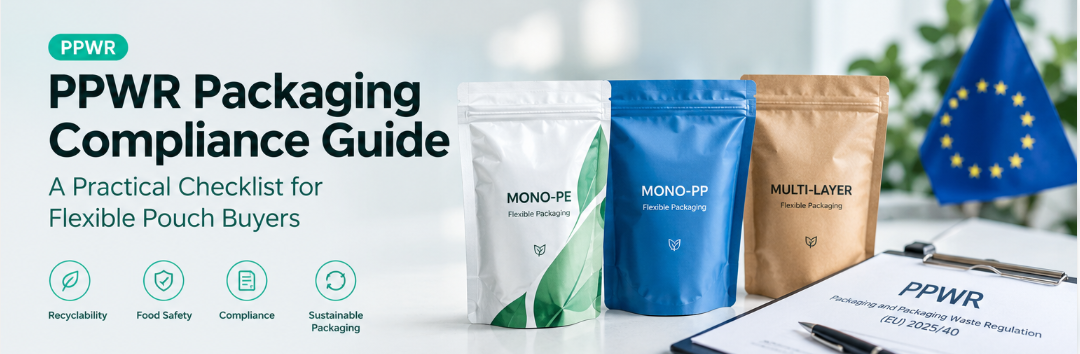
The EU Packaging and Packaging Waste Regulation (PPWR), Regulation (EU) 2025/40, is changing how businesses select, design and document flexible packaging.
For food brands, coffee companies and packaging buyers, the key question is no longer simply whether a pouch is recyclable. It is whether the complete packaging structure meets applicable requirements while protecting the product.
This guide explains the essential PPWR requirements and provides a practical checklist for purchasing flexible packaging.
1. What Does PPWR Mean for Flexible Packaging?
PPWR generally began applying on 12 August 2026, with additional requirements introduced in stages.
| Timeline | Key Requirements | What Buyers Should Do |
|---|---|---|
| August 2026 | General application of PPWR, including applicable chemical restrictions and conformity obligations | Review material safety and supplier documentation |
| 2030 or later, depending on implementing rules | Harmonized design-for-recycling criteria and recyclability grades | Evaluate pouch structures and recycling compatibility |
| 2030 or later, subject to applicable timelines and exemptions | Minimum recycled-content requirements for relevant plastic packaging | Assess suitable recycled materials and food-contact restrictions |
| 2035 or later | Recycled-at-scale requirements | Review collection and recycling infrastructure |
| 2038 | Higher recyclability performance threshold | Plan longer-term packaging improvements |
Important: PPWR does not automatically prohibit flexible pouches or require every pouch to switch to mono-material packaging immediately.
2. Four Key Areas Every Packaging Buyer Should Check
Material Structure and Recyclability
Packaging recyclability depends on more than the main plastic material.
Mono-PE and mono-PP structures can support recyclable packaging designs, but inks, adhesives, coatings, barrier layers, zippers and closures may affect recycling compatibility.
Buyers should request the complete material structure and evaluate it against relevant design-for-recycling criteria.
Chemical and Food-Contact Safety
Food-contact packaging must satisfy applicable chemical restrictions, including relevant PPWR limits on PFAS.
Request supporting documentation for films, inks, adhesives and other components. Food-contact compliance must also be assessed under the relevant EU food-contact legislation.
Recycled Content
PPWR introduces recycled-content targets for certain plastic packaging categories, subject to phased application dates and exemptions.
However, recycled plastic is not automatically suitable for direct food contact. Material selection must account for applicable food-contact requirements and the intended packaging application.
Technical Documentation
Buyers should confirm which conformity documents, material specifications and test reports are available for the finished packaging.
A generic statement such as “eco-friendly” or “food-safe” is not sufficient evidence of compliance.
3. Comparing Common Flexible Packaging Structures
| Packaging Structure | Main Advantage | Key PPWR Consideration |
|---|---|---|
| PET/AL/PE laminate | Excellent barrier protection | Multiple materials can complicate recycling |
| PET/VMPET/PE | Good barrier and visual appearance | Recycling compatibility requires evaluation |
| Mono-PE pouch | Flexible structure with potential PE recycling compatibility | Barrier layers, printing and closures must be assessed |
| Mono-PP pouch | Potential stiffness and thermal-performance advantages | Processing suitability and PP recycling compatibility require validation |
| Paper/plastic laminate | Paper-based appearance | Plastic layers may affect fiber recycling |
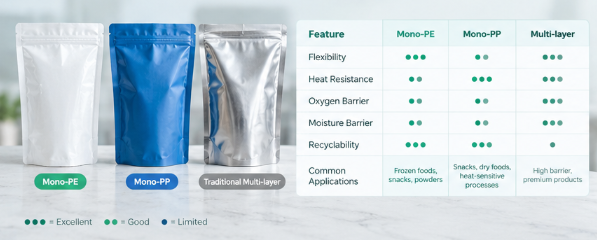
There is no universally PPWR-compliant material. The right structure depends on product protection, packaging design and applicable regulatory requirements.
4. PPWR Buyer Checklist: 8 Questions to Ask Your Supplier
Before confirming a custom pouch order, use this checklist:
| Check | Question to Ask | Documents or Information Needed |
|---|---|---|
| 1. Material | What is the complete film structure? | Material specification |
| 2. Recyclability | Is the structure compatible with the intended recycling stream? | Design-for-recycling assessment |
| 3. Food safety | Does it meet applicable food-contact requirements? | Relevant declarations and test reports |
| 4. Chemical restrictions | Have applicable PFAS and other substance restrictions been assessed? | Supplier declarations and supporting evidence |
| 5. Barrier performance | Does the pouch provide adequate oxygen and moisture protection? | OTR/WVTR test data |
| 6. Sealing | Is it compatible with the filling and sealing process? | Seal-strength and process testing |
| 7. Recycled content | Are recycled-content requirements applicable to this packaging? | Material composition and supporting records |
| 8. Documentation | Can the supplier support the required technical file? | Applicable conformity and technical documents |

Completing these checks before artwork approval can reduce redesign costs and production delays.
5. How to Prepare Your Packaging for PPWR
A practical transition does not always require replacing every packaging structure immediately.
Step 1 — Review existing packaging. Identify material combinations, pouch formats and current supplier specifications.
Step 2 — Prioritize difficult-to-recycle structures. Evaluate whether suitable mono-material alternatives are available.
Step 3 — Protect product performance. Compare oxygen barrier, moisture barrier, sealing strength and required shelf life.
Step 4 — Test before switching. Conduct packaging trials using the actual filling process and intended storage conditions.
Step 5 — Maintain documentation. Keep relevant specifications, test reports and conformity records for each packaging design.
6. Frequently Asked Questions
Are mono-PE pouches automatically PPWR-compliant?
No. Compliance depends on the complete packaging structure and the requirements applicable to its intended use.
Must all aluminum foil pouches be replaced immediately?
No. However, businesses should review their long-term recyclability strategy and evaluate alternatives where technically feasible.
Is mono-PP always better for hot-fill or retort packaging?
No. Certain PP structures may offer thermal advantages, but suitability must be verified through testing of the finished pouch and intended processing conditions.
Can recyclable packaging still provide high barrier protection?
Yes. Some recyclable-design structures can incorporate compatible barrier technologies. Performance and recycling compatibility must be evaluated together.
Conclusion
PPWR compliance requires more than choosing a recyclable material.
For flexible packaging buyers, the best approach is to evaluate the complete pouch structure, verify product performance and request reliable supplier documentation.
At FDXPACK, we support custom flexible packaging development with material selection, printing, pouch production and sampling options.
Whether you are exploring mono-PE, mono-PP or other flexible packaging structures, our team can help assess options based on your product requirements.https://www.yoemma.com/
Contact FDXPACK to discuss your custom packaging project.https://fdxpack.com/
References
- Regulation (EU) 2025/40 — Packaging and Packaging Waste Regulation
- European Commission — PPWR Implementation Guidance (2026)
Regulatory requirements and technical assessment methods may evolve. Confirm the rules applicable to your product, packaging category and market before making compliance claims.