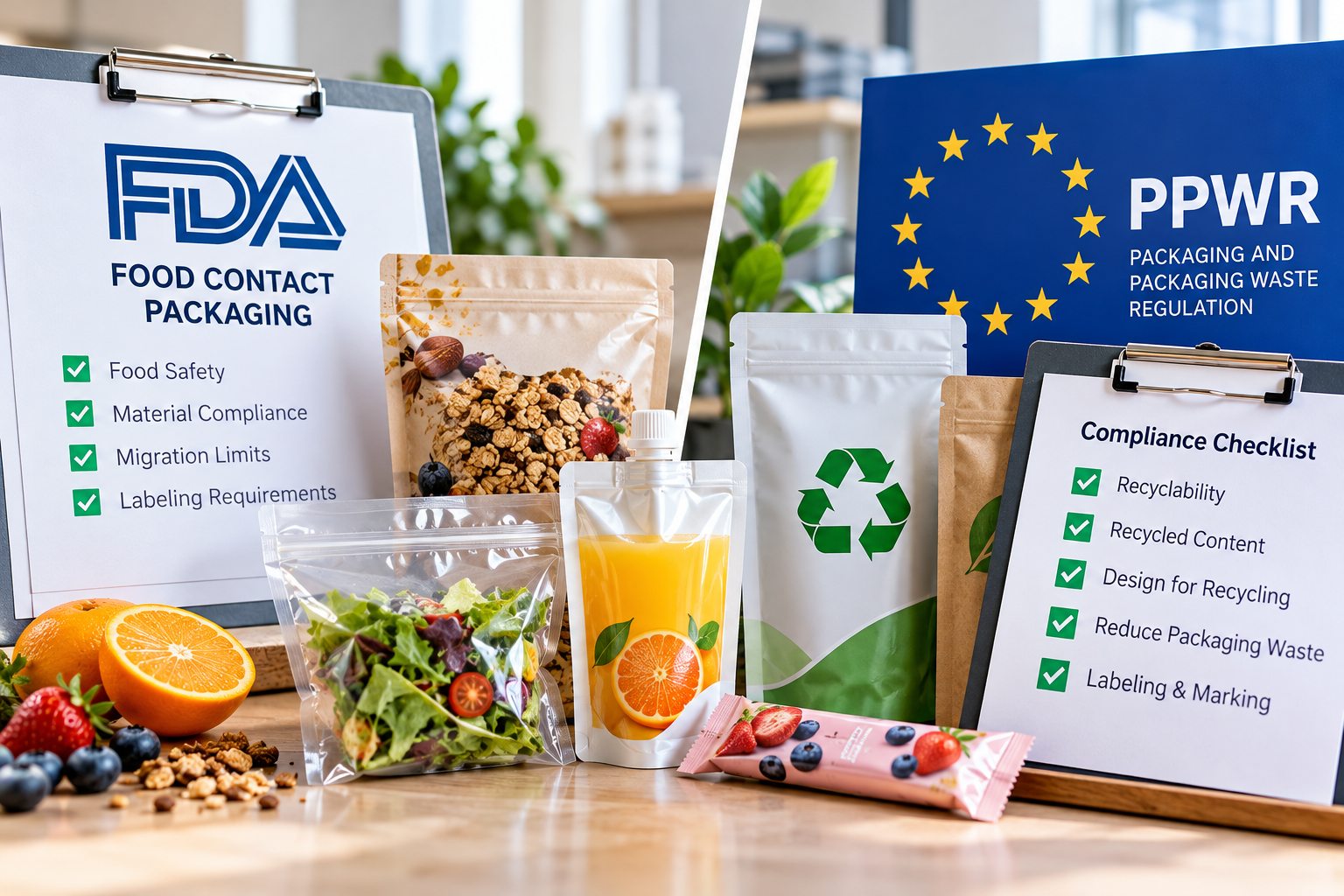
FDA food packaging requirements are a critical compliance foundation for food brands and packaging buyers.
Overlooking regulatory alignment early in the process can derail even fully designed packaging, forcing material reworks, delaying product launches by months, and adding substantial costs. Understanding these rules from the outset is not optional — it is a basic business necessity.https://fdxpack.com/
What is the FDA and Why Does It Matter for Packaging?
The FDA (Food and Drug Administration) is the United States federal agency responsible for protecting public health by regulating food safety, including food contact materials and packaging. The FDA establishes standards to ensure that packaging materials don't contaminate food products or pose health risks to consumers. For any company selling food products in the United States—whether you're a domestic producer or an international exporter—FDA compliance is mandatory, not optional. Non-compliant packaging can result in product recalls, import detention, legal liability, and severe brand damage. At FDXPACK, we hold FDA certification and understand these regulations thoroughly, ensuring that every packaging solution we provide meets all necessary requirements for the U.S. market.
Key FDA Requirements for Food Packaging Materials
FDA food packaging compliance involves several specific requirements that buyers must understand and verify. Here are the essential elements:
| Requirement | Description | Why It Matters |
|---|---|---|
| Material Approval | All materials must be FDA-approved for food contact | Prevents harmful chemical migration |
| Food Type Compatibility | Materials must be suitable for specific food categories (aqueous, fatty, acidic, dry) | Different foods interact differently with materials |
| Migration Testing | Verification that substances don't migrate from packaging to food | Ensures consumer safety |
| Good Manufacturing Practice (GMP) | Manufacturers must follow proper production standards | Maintains consistent quality and safety |
| Proper Documentation | Suppliers must provide certificates of compliance and test results | Proves regulatory compliance |
| Additives Approval | All additives (inks, adhesives, coatings) must be FDA-compliant | Indirect contact materials can also contaminate |
| Temperature Conditions | Materials must be approved for intended use temperatures (cold, room temp, hot) | Heat can increase migration |
| Contact Duration | Short-term vs. long-term storage requirements differ | Longer contact increases migration risk |
At FDXPACK, we ensure all these requirements are met and provide full documentation to support your regulatory compliance efforts.https://www.yoemma.com/
Common FDA-Approved Materials for Food Packaging
Understanding which materials are FDA-approved helps you make informed packaging decisions. Here's an overview of commonly used materials:
Polyethylene (PE): One of the most widely used FDA-approved materials for food packaging. Available in different densities (LDPE, HDPE, LLDPE), it's suitable for most food types including both dry and fatty foods. Used in bags, pouches, and liners.
Polypropylene (PP): Excellent heat resistance and chemical stability. FDA-approved for a wide range of food applications including hot-fill products. Commonly used in stand-up pouches and food containers.
Polyester (PET): Strong, clear, and chemically resistant. FDA-approved and frequently used for food and beverage packaging. Offers good barrier properties and is suitable for both dry and liquid foods.
Aluminum Foil: Provides excellent barrier against oxygen, moisture, light, and odors. FDA-approved and considered safe for direct food contact. Often used in laminates for maximum product protection.
Paper and Paperboard: FDA-approved when properly treated and used with appropriate coatings or liners. Must meet specific purity standards and avoid harmful chemicals.
At FDXPACK, we work primarily with multilayer laminates that combine these FDA-approved materials to achieve optimal barrier properties while maintaining full regulatory compliance.
What Documentation Should You Request from Suppliers?
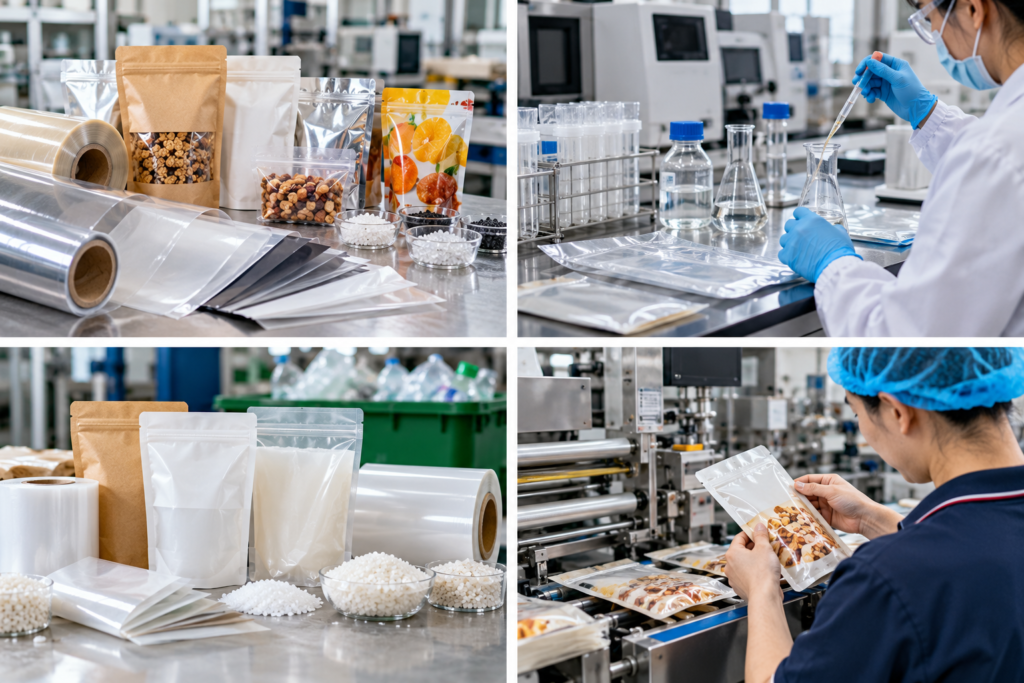
When sourcing food packaging, proper documentation is your proof of compliance. Never accept packaging without verifying FDA compliance through appropriate documentation. Here's what you should request:
FDA Compliance Certificate: A statement from the manufacturer confirming that materials meet FDA requirements for food contact. This should specify which FDA regulations apply (e.g., 21 CFR 177.1520 for polyolefin films).
Migration Test Results: Laboratory reports demonstrating that the packaging does not allow harmful migration under intended use conditions. Tests should match your specific food type and storage conditions.
Material Safety Data Sheets (MSDS): Technical documents detailing the chemical composition and safety information for all packaging components.
Good Manufacturing Practice (GMP) Certification: Evidence that the manufacturer follows proper quality control and production standards.
Specifications Sheet: Detailed information about material composition, structure, and intended use conditions.
Supplier's Declaration of Compliance: A formal statement that all materials, inks, adhesives, and additives used in the packaging are FDA-compliant.
At FDXPACK, we provide all necessary documentation automatically with every order, and we maintain comprehensive records to support your compliance needs during audits or regulatory inquiries.
Common FDA Compliance Mistakes to Avoid
Based on my experience working with international buyers, I've seen several recurring compliance mistakes that can be easily avoided with proper knowledge:
Mistake 1: Assuming all plastic is FDA-approved. Not all polymers are suitable for food contact, and even approved materials must be produced under proper conditions.
Mistake 2: Neglecting printing inks and adhesives. These indirect food contact materials must also be FDA-compliant, as they can migrate through the packaging layers.
Mistake 3: Using packaging beyond its approved conditions. Material approved for cold storage may not be suitable for hot-fill applications or microwave heating.
Mistake 4: Failing to verify supplier claims. Always request and review actual compliance documentation rather than accepting verbal assurances.
Mistake 5: Ignoring food type specificity. Packaging approved for dry foods may not be suitable for fatty or acidic products.
Mistake 6: Overlooking additives and processing aids. Colorants, UV stabilizers, and other additives must all be FDA-compliant for food contact use.
Mistake 7: Not considering recycled content carefully. Recycled materials can be used in food packaging but require special FDA clearance and careful control.
At FDXPACK, we help clients navigate these potential pitfalls by providing expert guidance and ensuring every aspect of the packaging meets FDA requirements.
FDA vs. Other International Food Packaging Standards
While FDA compliance is essential for the U.S. market, many of our clients also need to meet other international standards. Understanding the differences helps you develop packaging that works across multiple markets:
| Standard/Region | Regulatory Body | Key Characteristics | Relationship to FDA |
|---|---|---|---|
| FDA (USA) | Food and Drug Administration | Specific material approvals, migration limits, GMP | Primary U.S. requirement |
| EU Regulations | European Food Safety Authority (EFSA) | Overall migration limits, specific migration limits | Similar goals, different details |
| BRC (UK/Global) | British Retail Consortium | Quality and safety management standard | Complementary to FDA |
| FSSC 22000 | Foundation for Food Safety Certification | Comprehensive food safety management | Includes packaging requirements |
| China GB Standards | China National Standards | Specific Chinese requirements for food contact | Different from FDA requirements |
| Japan Food Sanitation Law | Ministry of Health, Labour and Welfare | Positive list system for food contact materials | Different approach from FDA |
At FDXPACK, we hold both FDA and BRC certifications, allowing us to serve clients across multiple international markets. We can help you navigate the requirements of different regions and develop packaging solutions that meet multiple standards simultaneously where possible.
FDXPACK's Commitment to FDA Compliance
As Emma Xiao, I personally oversee our compliance program to ensure every client receives packaging that meets FDA requirements without compromise. With 17 years of experience in the packaging industry, I understand that regulatory compliance is not just about checking boxes—it's about protecting your customers and your brand reputation. At FDXPACK, our FDA certification reflects our commitment to proper materials, manufacturing processes, and quality control. We work exclusively with approved material suppliers, maintain detailed documentation for every product, conduct regular compliance reviews, and stay current with regulatory changes. We also hold BRC food-grade certification, which demonstrates our comprehensive approach to food safety and quality management. When you work with FDXPACK, you receive not just packaging but peace of mind that your products meet all necessary regulatory requirements for the U.S. market and beyond.
Conclusion
FDA food packaging requirements are complex but essential for any company selling food products in the United States. Understanding material approvals, food type compatibility, migration testing, and proper documentation protects your business from regulatory issues, product recalls, and brand damage. As a packaging buyer, you must verify FDA compliance through proper documentation and work with certified suppliers who understand these requirements thoroughly. At FDXPACK, we combine FDA and BRC certifications with 17 years of industry experience to provide packaging solutions that meet all regulatory requirements while supporting your product quality and brand objectives. Our commitment to compliance, quality, and customer service ensures that your packaging protects both your products and your business.
For expert guidance on FDA-compliant food packaging solutions, contact us today.
Email: emma@fdxpack.com
Website: www.fdxpack.com