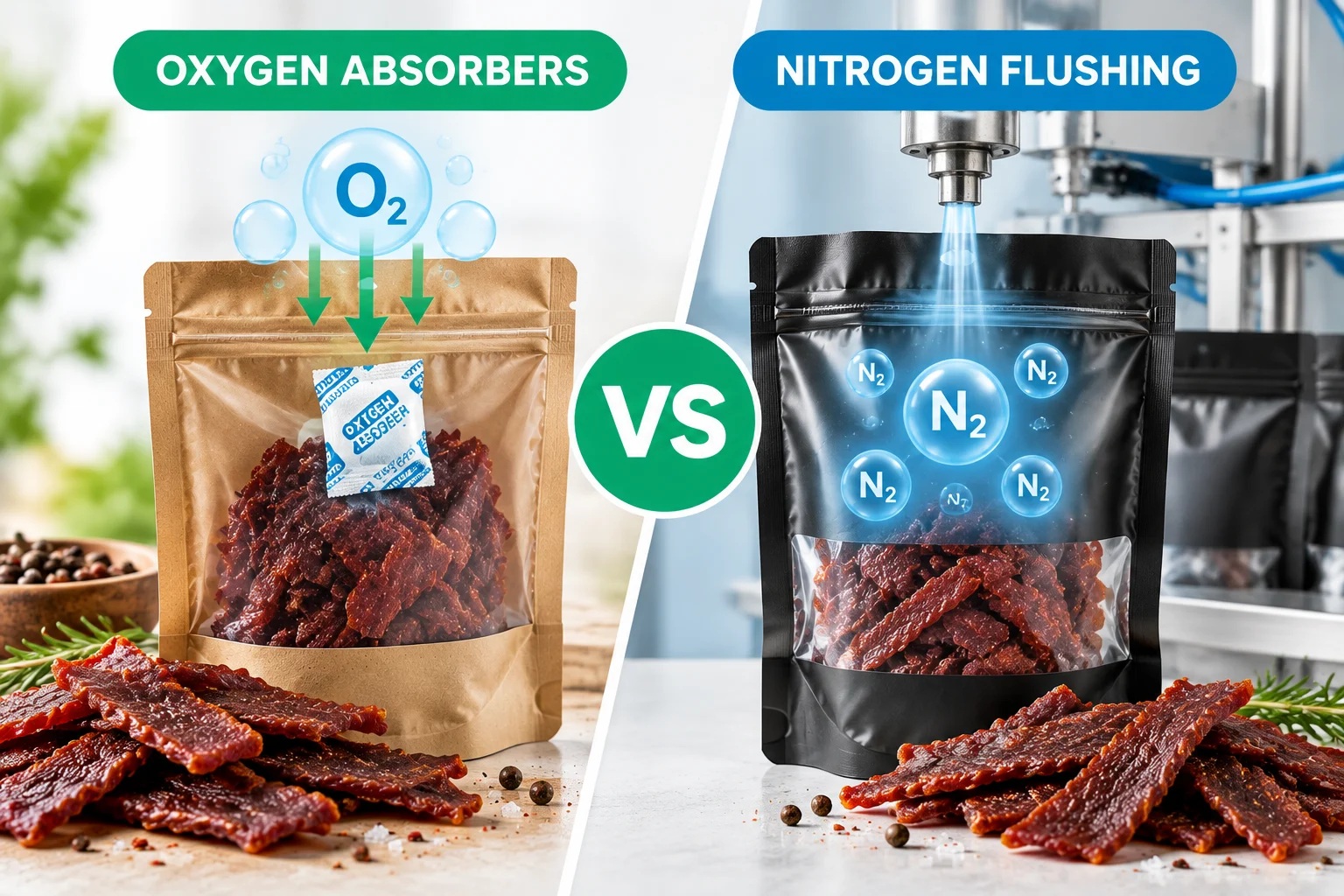
Beef jerky packaging needs to protect product quality during storage and transportation. Oxygen exposure can contribute to flavor deterioration, fat oxidation, and changes in product quality.
Two common oxygen-control methods are oxygen absorbers and nitrogen flushing. Although both can help reduce oxygen-related deterioration, they work differently and may be used separately or together depending on the product and packaging process.
1. What Is an Oxygen Absorber?

An oxygen absorber is a small sachet placed inside a package to remove residual oxygen after sealing. Many commercial oxygen absorbers use iron-based chemistry to react with oxygen inside the package.
Key benefits:
- Helps reduce residual oxygen after packaging.
- Can continue absorbing oxygen that remains or enters the package, provided the absorber has sufficient capacity.
- Can complement high-barrier packaging materials.
Important considerations:
- The absorber must be suitable for the product and package volume.
- Its capacity must match the expected oxygen load.
- Packaging seals and barrier properties must prevent excessive oxygen entry.
- The sachet must be approved for its intended food-packaging application and handled according to its instructions.
An oxygen absorber does not replace proper food processing, sanitation, or shelf-life validation.
2. What Is Nitrogen Flushing?
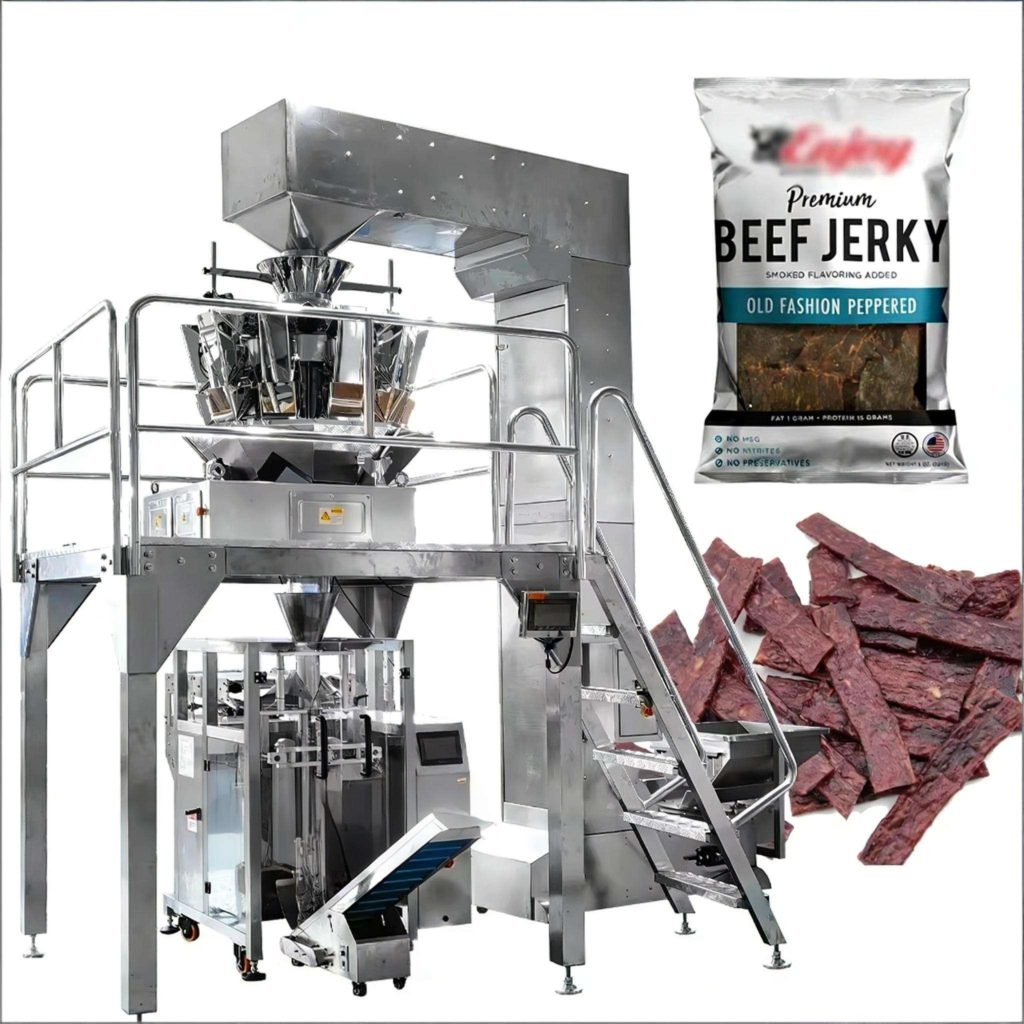
Nitrogen flushing is a packaging process in which nitrogen gas is introduced into the package to displace some of the air before sealing.
It is commonly used for products where oxygen exposure needs to be controlled.
Key benefits:
- Reduces oxygen in the package headspace when the process is properly controlled.
- Can be integrated into automated packaging lines.
- Does not require an oxygen-absorber sachet when used as a standalone method.
Important considerations:
- Residual oxygen depends on equipment, gas flow, package design, and operating conditions.
- Nitrogen flushing does not automatically remove all oxygen.
- Reliable sealing is essential to maintain the intended atmosphere.
- The process requires suitable gas delivery and packaging equipment.
3. Oxygen Absorbers vs. Nitrogen Flushing: Key Differences
| Comparison Factor | Oxygen Absorbers | Nitrogen Flushing |
|---|---|---|
| Working Principle | Chemically absorbs oxygen | Displaces air with nitrogen |
| Application | Sachet inserted before sealing | Gas introduced during filling and sealing |
| Equipment | Requires suitable sachet handling | Requires gas supply and flushing equipment |
| Residual Oxygen | Reduced after sealing as absorption proceeds | Reduced during the packaging process |
| Ongoing Oxygen Control | Depends on remaining absorber capacity | Depends on package integrity and barrier performance |
| Best Fit | Suitable products and controlled package volumes | Production lines suited to gas flushing |
Neither method is universally better. The appropriate choice depends on the product, production process, packaging material, target shelf life, and operating costs.
4. Can Both Methods Be Used Together?
Yes. Some beef jerky packaging systems combine nitrogen flushing with an oxygen absorber to provide additional oxygen control.
Nitrogen flushing reduces oxygen during packaging, while an absorber can remove residual oxygen after sealing.
However, using both methods increases process complexity and cost. The combination should be justified by product-specific testing rather than assumed to be necessary for every product.
5. Why High-Barrier Packaging Still Matters
Oxygen-control methods work best when combined with packaging that limits oxygen transmission and maintains reliable seals.
Even after flushing or inserting an absorber, oxygen can enter through the film or defective seals.
Common material structures considered for beef jerky packaging include:
| Material Structure | Main Consideration |
|---|---|
| PET/PE | Printability and heat sealing; barrier performance depends on the structure |
| PET/VMPET/PE | Enhanced oxygen, moisture, and light protection options |
| PET/AL/PE | High-barrier structure options for demanding protection requirements |
| Mono-PE | Potential recycling-oriented option; barrier performance must be validated |

Explore our High Barrier Packaging options for flexible packaging applications requiring oxygen and moisture protection.
Material selection should consider oxygen transmission, water vapor transmission, puncture resistance, seal strength, and the intended storage conditions.
A zipper can provide convenient resealing after opening, but it does not replace the initial hermetic heat seal required by the packaging process.
For products requiring vacuum packaging, explore our Vacuum Packaging Bags solutions.
6. How Should Buyers Choose the Right Solution?
Before selecting an oxygen-control method, beef jerky brands and packaging buyers should review the following:
- Product characteristics: Formulation, fat content, moisture, water activity, and piece size.
- Target shelf life: The required storage period and distribution conditions.
- Packaging structure: Film barrier properties, pouch dimensions, and seal performance.
- Production capability: Whether the line supports gas flushing, absorber insertion, or both.
- Validation requirements: Residual oxygen measurements, package integrity, and product-specific shelf-life studies.
Packaging is only one part of product preservation. The responsible food manufacturer must validate the complete process to establish appropriate quality and food-safety controls.
Frequently Asked Questions
Are oxygen absorbers better than nitrogen flushing?
Not necessarily. Oxygen absorbers remove residual oxygen after sealing, while nitrogen flushing reduces oxygen during packaging. The better option depends on the product and production requirements.
Does nitrogen flushing eliminate all oxygen?
No. The remaining oxygen level depends on the equipment, flushing conditions, package design, and sealing process.
Can oxygen absorbers replace high-barrier packaging?
No. Absorbers have limited capacity, and oxygen may enter through permeable materials or defective seals. Appropriate barrier packaging remains important.
Can beef jerky packaging use recyclable materials?
Potentially. Mono-material structures may support recycling-oriented designs, but the complete package must be evaluated for barrier performance, sealing, closure compatibility, and the requirements of the target market.
Conclusion
Oxygen absorbers and nitrogen flushing offer different ways to control oxygen in beef jerky packaging. Some products may benefit from one method, while others may require a combined approach.
The best solution balances product protection, packaging performance, production efficiency, and validated shelf-life requirements.
Need Custom Beef Jerky Packaging Bags?
FDXPACK offers custom flexible packaging options, including pouch structures, barrier material choices, custom printing, and zipper features.
Explore our Custom Beef Jerky Packaging Bags solutions or contact our team to discuss your packaging specifications and quotation requirements.
Website: https://fdxpack.com/
Email: sales@packagingcompany.com