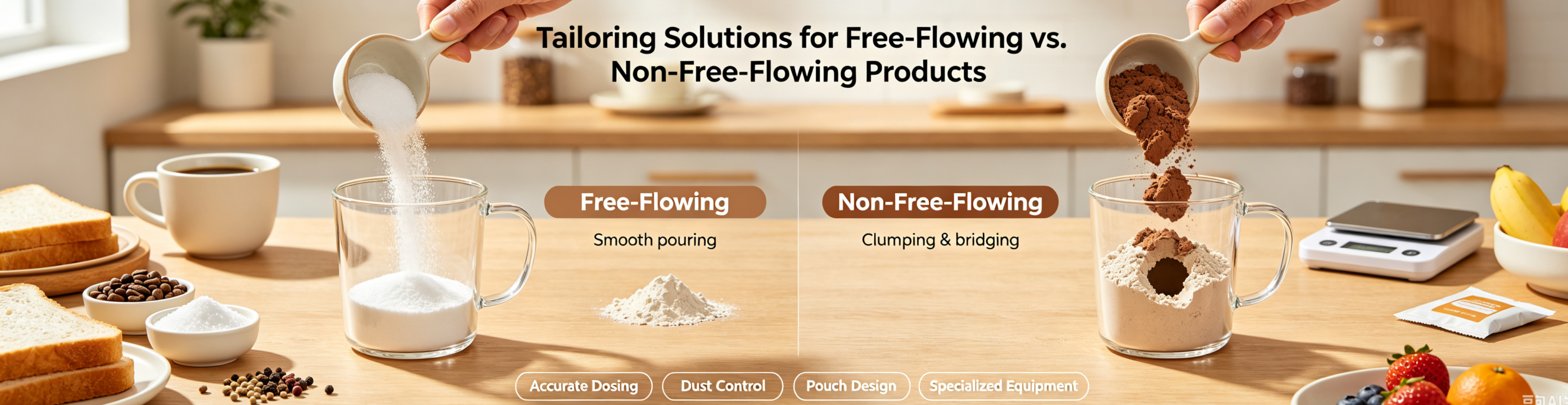
Free-flowing and non-free-flowing products require distinctly tailored packaging solutions.
A powder’s physical properties directly shape filling efficiency, sealing reliability and product protection, making this distinction the first critical step in selecting the right packaging approach.https://fdxpack.com/
What are Free-Flowing Powders?
Free-flowing powders are substances where individual particles move easily and independently from one another. Think of sugar, salt, instant coffee, or granular spices. When poured, they flow smoothly and consistently, often resembling a liquid. Their particles are typically uniform in size and shape, with low inter-particle friction and minimal moisture content. This characteristic makes them relatively easy to handle and fill into packaging, as they don't tend to clump, bridge, or stick to machinery. However, their fluidity also presents unique challenges, such as dusting during filling and ensuring precise volumetric measurements. Accurate dosing and preventing product loss are key considerations when packaging free-flowing powders.https://fdxpack.com/powder-packaging-bags-manufacturer/

What are Non-Free-Flowing Powders?
Non-free-flowing powders, in contrast, are characterized by particles that tend to stick together, clump, or bridge, making them difficult to handle and fill. Examples include flour, protein powder, cocoa powder, finely ground spices, and certain powdered dairy products. These powders often have irregular particle shapes, higher moisture content, or electrostatic charges that cause them to adhere to each other and to equipment surfaces. When poured, they may flow erratically, create voids in the package, or even stop flowing altogether. Packaging non-free-flowing powders requires specialized machinery and careful consideration of bag design to ensure accurate filling, minimize mess, and maintain product integrity.
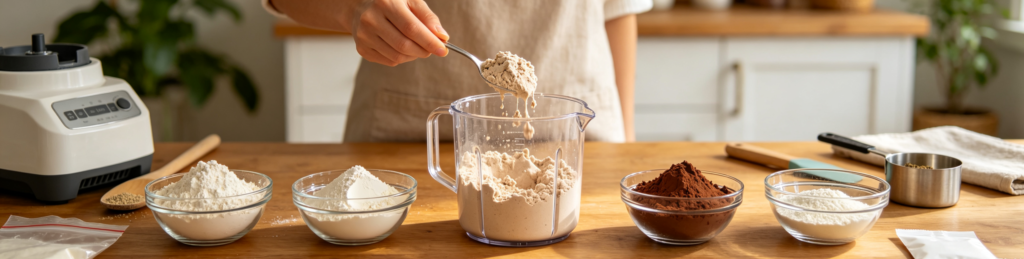
Key Differences: Free-Flowing vs. Non-Free-Flowing Powders
Understanding the core distinctions between these two powder types is crucial for making informed packaging decisions.
- Particle Movement: Free-flowing particles move independently; non-free-flowing particles stick together.
- Flow Behavior: Free-flowing powders flow smoothly and consistently; non-free-flowing powders flow erratically, clump, or bridge.
- Angle of Repose: Free-flowing powders have a low angle of repose; non-free-flowing powders have a high angle of repose.
- Filling Accuracy: Generally easier to achieve consistent fill weights with free-flowing powders; more challenging with non-free-flowing powders without specialized equipment.
- Dusting vs. Clumping: Free-flowing powders are prone to dusting; non-free-flowing powders are prone to clumping and bridging.
- Equipment Needs: Free-flowing powders often use volumetric or simple auger fillers; non-free-flowing powders require auger fillers with agitators, vibratory feeders, or specialized tooling.
Powder Characteristics: A Comparative Table
Here's a concise overview to highlight the differences in packaging considerations:
| Characteristic | Free-Flowing Powders | Non-Free-Flowing Powders |
|---|---|---|
| Examples | Sugar, salt, instant coffee, rice, granular spices | Flour, protein powder, cocoa, powdered milk, fine spices |
| Particle Behavior | Move independently, low inter-particle friction | Stick together, clump, bridge, high inter-particle friction |
| Flow Consistency | Smooth, consistent | Erratic, intermittent, prone to blockages |
| Common Issues | Dusting, precise dosing | Clumping, bridging, sticking to surfaces, inaccurate filling |
| Filling Equipment | Volumetric fillers, simple auger fillers | Auger fillers with agitators, vibratory fillers |
| Packaging Features | Good seals, tear notches, sometimes pour spouts | Robust zippers, anti-static films, wider openings, scoops |
| Barrier Needs | Often moisture/oxygen barrier | Moisture/oxygen barrier, sometimes anti-static |
Packaging Considerations for Free-Flowing Powders
For free-flowing powders, the packaging goal is often precision, protection, and consumer convenience, especially regarding dispensing.
- Bag Formats: Stand-up pouches, 3-side seal pouches, and stick packs are all excellent choices. Stick packs are particularly popular for single-serve portions of instant coffee or sugar due to their easy-pour design. Stand-up pouches offer great shelf presence for larger quantities.
- Material Selection: Barrier films are crucial to protect against moisture absorption, which can cause clumping, and oxygen, which can degrade flavor or potency. We use multi-layer films, often including metallized layers or aluminum foil, to ensure product integrity.
- Sealing: Strong, consistent seals are paramount to prevent leakage of fine powders and maintain the barrier properties.
- Features: Easy-pour spouts or tear notches can enhance consumer convenience. For products like sugar, a simple tear-off top might suffice.
https://www.yoemma.com/At FDXPACK, we ensure that the chosen material and bag format provide the necessary barrier and functionality while optimizing for efficient filling and a positive consumer experience.
Packaging Considerations for Non-Free-Flowing Powders
Packaging non-free-flowing powders requires careful design to mitigate their inherent challenges during both filling and consumer use.
- Bag Formats: Stand-up pouches and quad-seal bags are frequently chosen. Stand-up pouches with wider openings make it easier for consumers to scoop out the product without making a mess. Quad-seal bags offer excellent stability and a premium feel for heavier products like large protein powder bags.
- Material Selection: Films with anti-static properties can be beneficial to prevent powder from clinging to the inside of the pouch, ensuring a clean pour or scoop. Robust barrier films are still essential for protection against moisture and oxygen.
- Sealing and Zippers: Resealable zippers are almost a necessity for multi-use products like protein powders or baking mixes. The zipper must be strong and designed to close effectively even if some powder residue is present.
- Scoop Inclusion: Many non-free-flowing powders benefit from an included scoop, which can be easily placed inside a wider-mouthed stand-up pouch.
Our team at FDXPACK understands these specific needs and can customize packaging solutions that facilitate efficient filling and provide a frustration-free experience for the end-user, maintaining the product's quality through its entire lifecycle.
FDXPACK's Expertise in Your Powder Packaging Choice
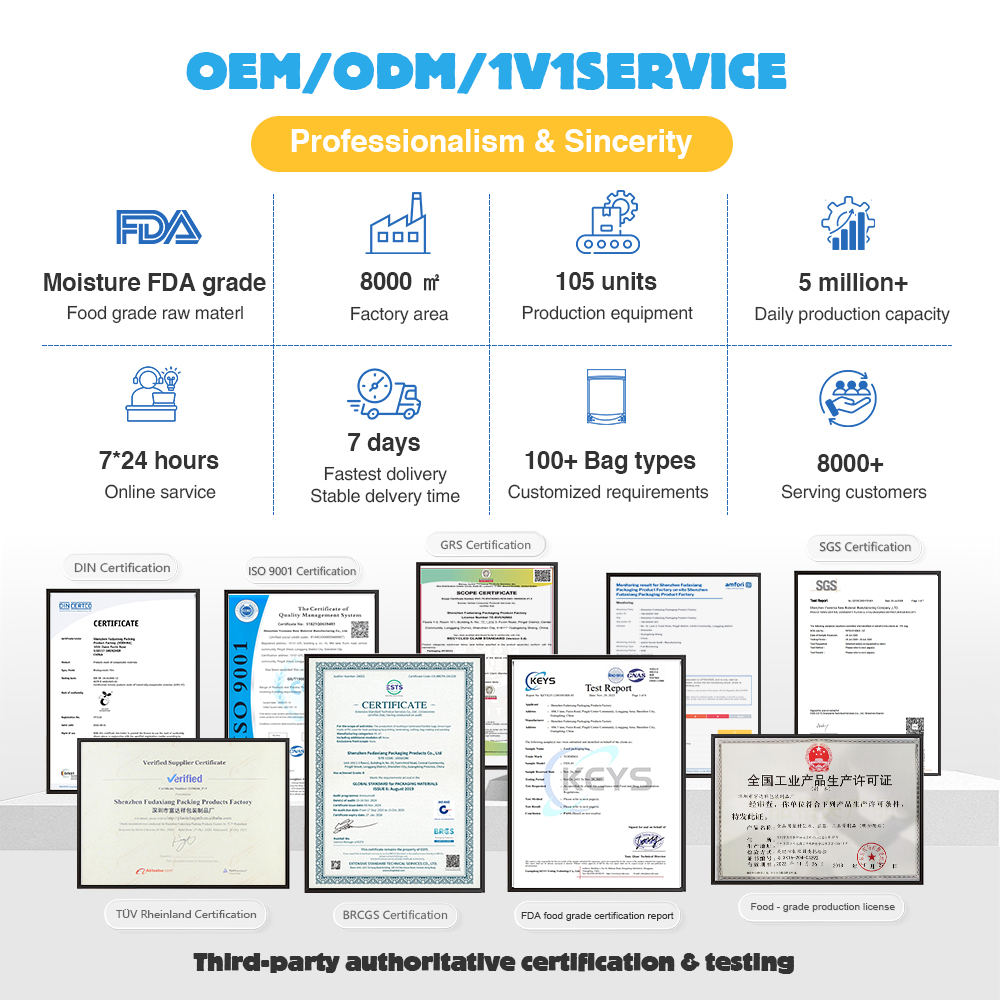
At FDXPACK, our 17 years of experience are dedicated to solving complex packaging challenges for our global clients. As Emma Xiao, I work closely with brand owners, large buyers, and traders across North America, Europe, and Asia to navigate the specific demands of packaging powdered foods. Whether your product is a finely ground, free-flowing spice or a sticky, non-free-flowing protein powder, we possess the expertise to recommend and customize the ideal packaging solution. We advise on the optimal bag formats—be it stand-up pouches, 3-side seal, quad-seal, or stick packs—and select the perfect multi-layer barrier films to protect against moisture, oxygen, and light, crucial for maintaining your product's quality and extending its shelf life. Our FDA and BRC food-grade certifications mean you can trust FDXPACK to deliver high-quality, safe, and effective packaging that ensures your product's integrity from our factory to your customer's hands. We focus on delivering tailored quality, not just low prices, because your product deserves the best.
Conclusion
The physical characteristics of your powdered food product—whether it's free-flowing or non-free-flowing—are fundamental to designing effective and efficient packaging. Free-flowing powders demand precision in dosing and protection from moisture, often benefiting from formats like stick packs or stand-up pouches with pour spouts. Non-free-flowing powders require robust solutions that prevent clumping, ensure accurate filling, and offer consumer convenience through features like wide openings and strong resealable zippers in formats like stand-up or quad-seal pouches. By carefully considering these differences and partnering with an experienced, quality-focused manufacturer like FDXPACK, you can ensure your packaging not only protects your product but also enhances its usability and market appeal. Making the right choice is paramount to your product's success and your brand's reputation.
For expert guidance on customizing the ideal packaging solution for your powdered food products, please reach out.
Email: emma@fdxpack.com
Website: www.fdxpack.com