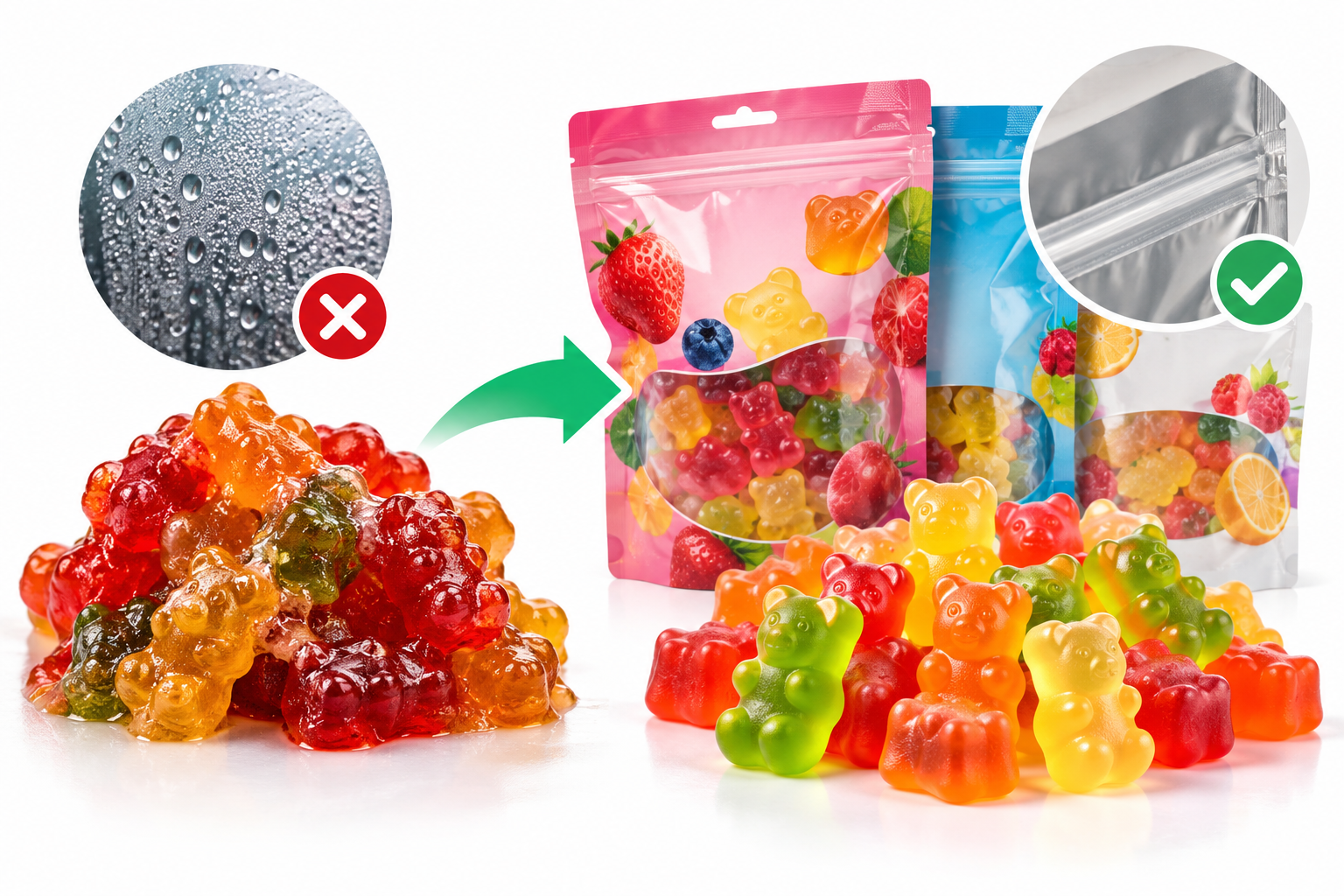
Gummy candies can become sticky, clump together, or lose their original texture during storage. This is a common challenge for gummy manufacturers, especially when products are exposed to moisture, temperature changes, or improper packaging conditions.
Understanding the causes of stickiness is essential for maintaining gummy quality and extending shelf life.
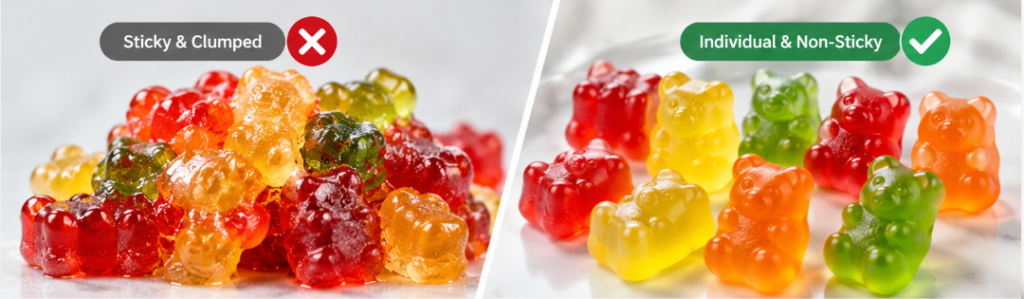
1. Why Do Gummies Stick Together?
Gummy stickiness is mainly related to moisture, ingredients, and production conditions.
Excess Moisture
When gummies contain too much available water, moisture can migrate toward the surface, creating a sticky texture. High water activity can increase the risk of clumping during storage.
Improper Drying
Insufficient or uneven drying may leave excess moisture inside gummies. Over time, this moisture can affect surface texture and product stability.
Ingredient Formulation
Sugars, acids, gelatin, pectin, and other ingredients influence how gummies retain and absorb moisture. Certain formulations are more sensitive to humidity than others.
Temperature Changes
Temperature fluctuations during production, transportation, and storage may contribute to moisture redistribution, condensation, and changes in gummy texture.
2. Control Moisture During Production
Proper moisture management is one of the most effective ways to prevent gummies from sticking together.
Manufacturers should focus on:
- Controlled drying: Allow sufficient drying or conditioning time before packaging.
- Water activity: Monitor water activity to evaluate moisture availability and product stability.
- Consistent processing: Maintain suitable production temperature and humidity.
- Batch inspection: Check gummy texture and moisture consistency before packaging.
The ideal drying conditions depend on the gummy formulation, ingredients, and manufacturing process.
3. Store Gummies Under Suitable Conditions
Even properly manufactured gummies may become sticky when exposed to unfavorable storage conditions.
| Storage Factor | Potential Problem | Recommended Action |
|---|---|---|
| High Humidity | Moisture absorption and surface stickiness | Maintain controlled humidity |
| High Temperature | Softening and texture changes | Avoid excessive heat |
| Temperature Fluctuations | Condensation and moisture redistribution | Maintain stable storage conditions |
| Poor Packaging Seals | Moisture entering the package | Verify seal integrity |
| Long Storage Periods | Gradual texture deterioration | Validate product shelf life |
Storage conditions should be selected according to the specific gummy formulation and packaging system.
4. Use Suitable Coatings to Reduce Stickiness
Surface treatments can help prevent gummies from adhering to one another.
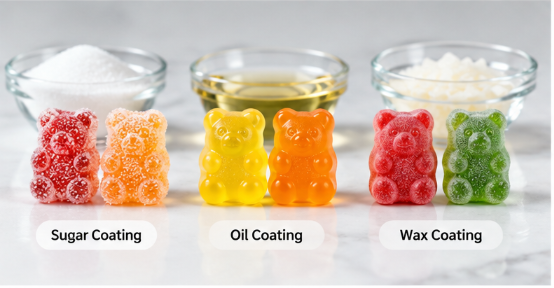
Oil and Wax Coatings
Food-grade oil or wax coatings can form a thin protective layer around gummies, reducing direct contact between sticky surfaces.
The coating type and application amount should be selected according to the product formulation.
Sugar Coatings
Sugar sanding creates a dry outer layer and provides additional texture.
However, some sugar-and-acid coatings can absorb moisture under humid conditions, potentially increasing stickiness during storage.
Choosing the Right Coating
| Coating Type | Main Benefit | Key Consideration |
|---|---|---|
| Oil Coating | Reduces surface adhesion | Uniform application |
| Wax Coating | Creates a protective surface | Suitable coating amount |
| Sugar Sanding | Adds texture and surface coverage | Humidity sensitivity |
| Acid-Sugar Coating | Adds sour flavor | Potential moisture absorption |
Coating effectiveness should be evaluated through storage and shelf-life testing.
5. Choose Packaging That Protects Gummies from Moisture
Packaging plays an important role in maintaining gummy texture after production.
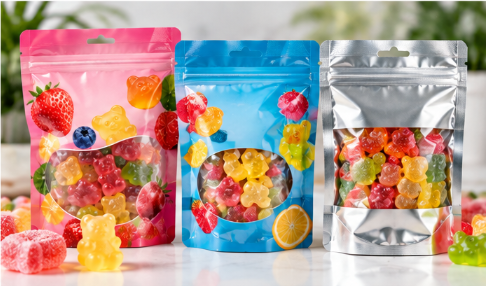
A suitable flexible pouch can help limit moisture exposure, reduce contamination risks, and protect the product during storage and transportation.
Moisture Barrier
Packaging films with suitable water vapor barrier properties can help reduce moisture transfer. Explore High Barrier Packaging options for moisture-sensitive gummy products.
Reliable Heat Sealing
Consistent heat seals help maintain package integrity and limit exposure to outside humidity.
Resealable Closures
For multi-serving gummy products, zipper closures can provide convenient repeated access. However, a zipper alone may not provide the same protection as an intact initial heat seal.
Suitable Packaging Size
Choosing appropriate pouch dimensions can reduce unnecessary empty space while maintaining sufficient room for filling and handling. Explore our Custom Candy Packaging Bags for different packaging options.
Common Packaging Materials for Gummies
| Material Structure | Main Advantage | Packaging Consideration |
|---|---|---|
| PET/PE | Good printability and heat sealing | Barrier suitability depends on structure |
| PET/VMPET/PE | Enhanced moisture and light protection | Suitable for evaluation in moisture-sensitive products |
| PET/AL/PE | High-barrier packaging options | Higher protection requirements |
| Mono-PE | Potential recyclable-design option | Barrier and sealing performance require validation |
The best material depends on gummy formulation, target shelf life, storage conditions, and packaging requirements.
6. How to Keep Gummies from Sticking: A Practical Checklist
Before packaging gummies, manufacturers should verify the following:
| Checkpoint | Recommended Action |
|---|---|
| Moisture Content | Confirm appropriate drying and conditioning |
| Water Activity | Monitor product-specific target values |
| Surface Coating | Check coating uniformity and stability |
| Storage Conditions | Control temperature and humidity |
| Packaging Material | Select suitable moisture-barrier properties |
| Heat Sealing | Check seal strength and package integrity |
| Shelf-Life Testing | Evaluate texture and stickiness over time |
Addressing these factors together is more effective than relying on packaging or surface coatings alone.
Conclusion
Preventing gummies from sticking together requires careful control of moisture, formulation, drying, surface treatment, storage, and packaging.
By maintaining suitable production conditions and choosing packaging with appropriate moisture protection and sealing performance, manufacturers can help preserve gummy texture and product quality throughout the intended shelf life.
Contact Us
Need custom gummy candy packaging bags?
Contact FDXPACK for custom pouch sizes, barrier material options, printing, and packaging quotations.
Website: https://fdxpack.com/
Email: emma@fdxpack.com
Contact: https://fdxpack.com/contact/